



From Paris to Jaipur, the legacy of the luxury steamer trunk, one of the purest remaining expressions of craftsmanship and collectable design, lives on in the world’s great ateliers.
Words by Megan Tomas
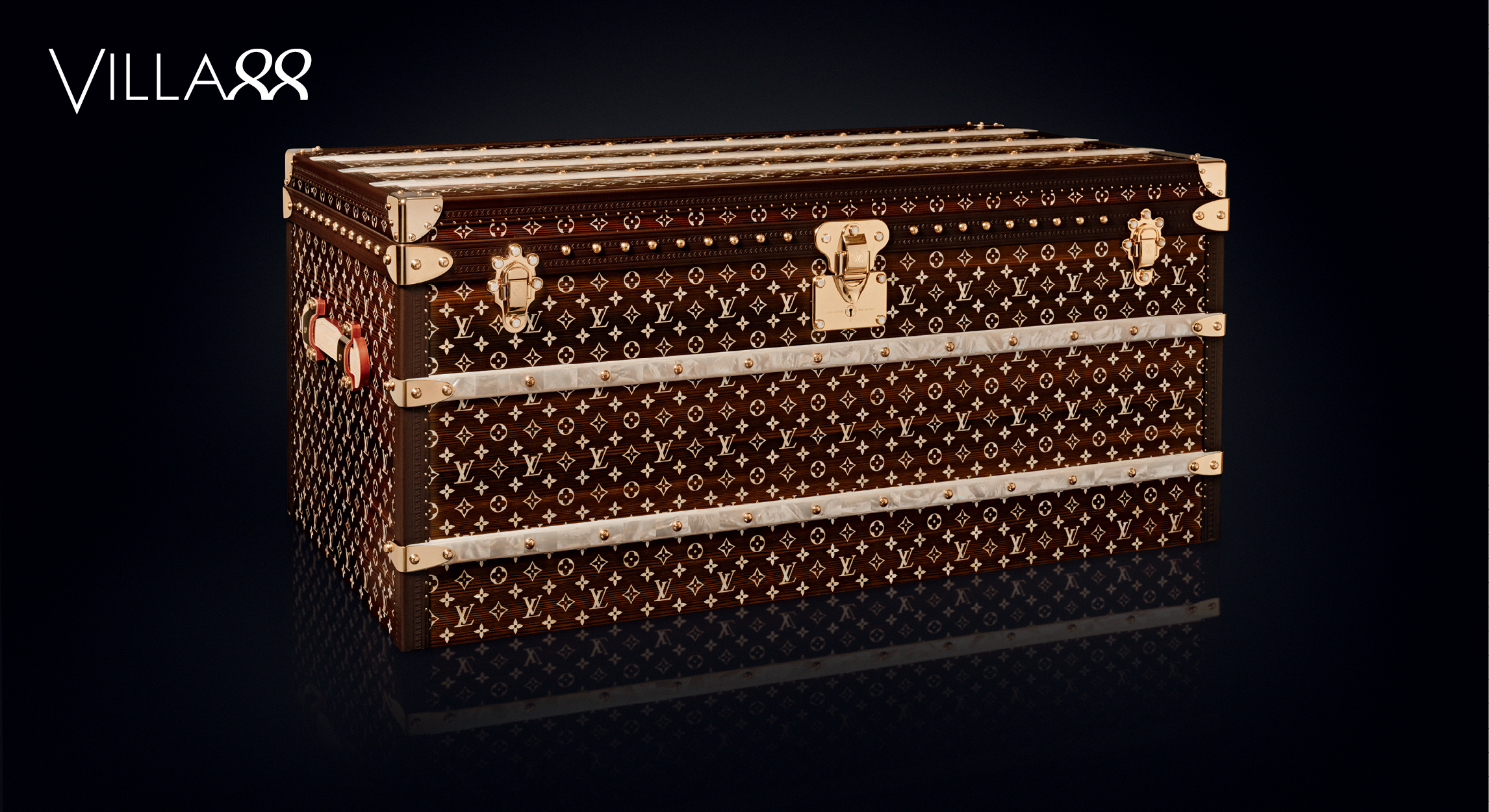
At Louis Vuitton’s Spring-Summer 2027 menswear show in Paris, Pharrell Williams presented The Chrome Wave, a complete reconstruction of the Maison’s historic Courrier Lozine 110 in waved, chromed acrylic glass.

Alongside it was a trunk finished entirely in mother-of pearl and larch marquetry, made in collaboration with a specialist French marquetry atelier.
In the 19th century, a steamer trunk like this was considered a workhorse. But in the century since, it has
evolved from a necessity into one of the most coveted objects in luxury, perhaps even the clearest expression of craftsmanship itself. At a time when exclusivity can be engineered through waiting lists and carefully managed scarcity, the one thing that cannot be hurried is the work of human hands. And few can make that argument more convincingly than Paritosh Mehta, founder of Trunks Company Jaipur.

The Indian brand’s ateliers may in fact be the most exacting still operating anywhere in the world. Five
specialist craft divisions – wood, metal, leather, stone, and illumination – produce fewer than a hundred trunks a year. Each one takes upwards of 2,800 hours, a rarity in an industry otherwise organised entirely around speed.
“We have consciously chosen a different path,” Paritosh says. “Our objective has never been to produce more. It has always been to create better.”
Trunks Company Jaipur’s global clientele includes Gulf royals, with one reported commission selling for a princely sum of $165,000, created with the sole purpose of being admired for the rest of its existence as a bespoke object of art and design.
Their ateliers operate with a refusal to treat craft as something stagnant. During its creation, a single trunk
will move through roughly 30 individual processes. It will be hand-painted and hand-cast in-house using centuries old methods, nearly all of them completed under one roof.

And all of this was an intuitive decision, Paritosh says. “It simply felt like the most compelling canvas upon
which multiple artistic disciplines, materials, and cultural narratives could coexist,” the founder explains. “Every trunk carries a visual language, but more importantly, it carries a spirit. That spirit is drawn from India’s cultural heritage, its architecture, its traditions, its craftsmanship, and the countless stories that have shaped our civilisation over centuries.”
Time itself, then, is not seen as an obstacle. Rather, it enables artisans to be custodians of a “living cultural
narrative, one that honours the past while continuing to evolve with every generation”.

This is the kind of sentiment that wouldn’t sound out of place coming from Asnières, Louis Vuitton’s atelier outside Paris, either. The French Maison still trains artisans in the same sequence it always has since 1859 – carpentry, canvas ribbing, and the art of meticulous lozinage nailed along every seam.
What has changed at Louis Vuitton, perhaps, isn’t the technique itself, but the ambition placed upon it. At
Milan Design Week 2026, the Maison revived the Malle Lit, the folding-bed trunk from the house’s 19th-century archive, unveiling it as a serious work of collectable design rather than a curiosity from the vitrine.
That same conviction, though no less absolute, runs through several other legacy luxury Maisons. Paris
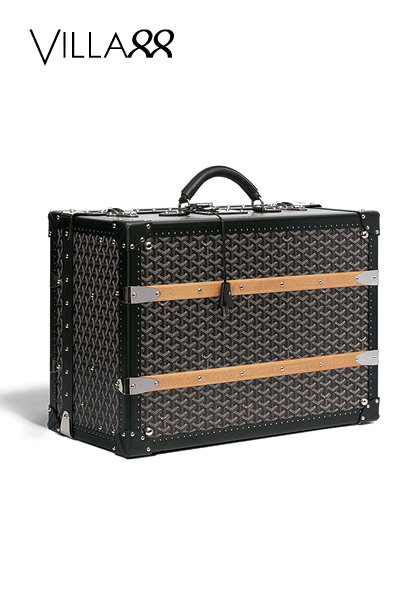
based Moynat, for one, recently spent years rebuilding its workshops to meet the same exacting standard of its original 1849 atelier, with each piece still being made entirely by hand. Goyard, older still, builds its trunks over several weeks in Carcassonne, each hand-finished with marquage in the same manner as its 1792 practice.

What the continued lineage of trunks is actually selling today, in every case, is a signal of true luxury. Proof of the hours inside the object, and evidence, as Paritosh puts it, that “there comes a point where craft transcends technique and becomes art”.
On a related note, he reveals that one of Trunks Company Jaipur’s most memorable moments came when a collector chose to replace a commissioned painting by an Indian Old Master with one of the company’s trunks.
“For me,” says Paritosh, “that decision spoke volumes. It reflected the way our work had begun to exist within conversations traditionally reserved for art.”
Perhaps that explains why the trunk has survived the century that rendered it obsolete. It no longer needs to carry possessions across oceans. What it holds instead is scarcer and harder won – proof of craftsmanship in an otherwise saturated world. Proof that somebody was still given the time to make one thing properly.
PHOTOS: COURTESY OF THE BRANDS