


The UAE’s design story has long been told through its skyline. What is less visible, but no less significant, is what happens at the level of the object — the chair, the stool, the bench, the cabinet. A generation of Emirati furniture designers is now producing work that carries the weight of cultural memory without being burdened by it, translating AlSadu weaving, desert forms, agal headwear, and the geometry of the palm into pieces that hold their own in Milan, London, and beyond. These are five of them. Meet the three Emirati creatives shaping what endures in the contemporary home.
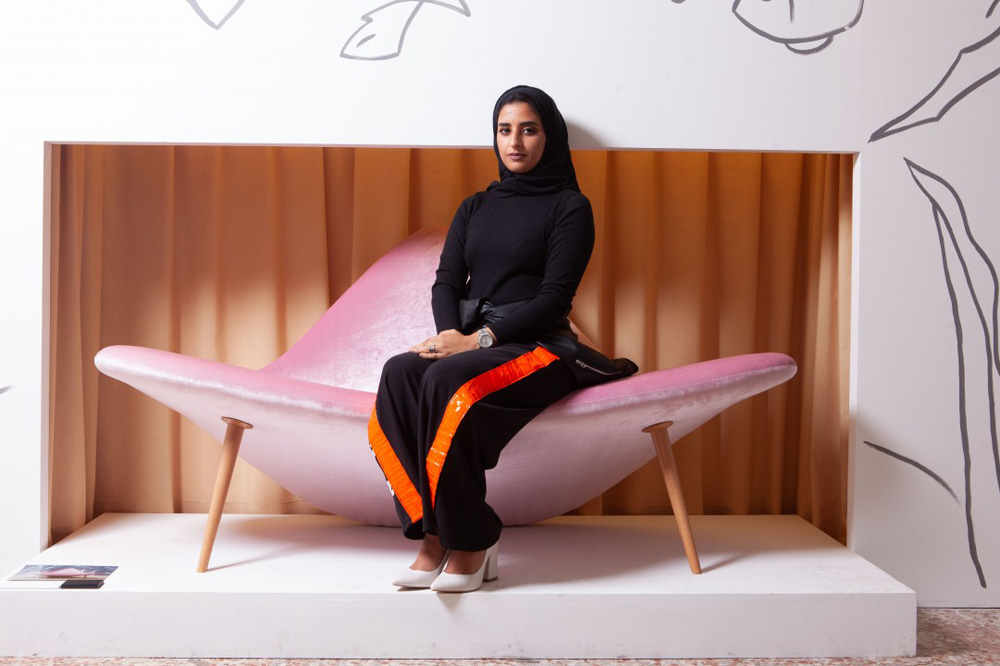
ALIA MAZROOEI
Alia Mazrooei is an Emirati interior and product designer who graduated from Zayed University with a Bachelor of Fine Arts in Interior Design in 2017, but she was already exhibiting before her degree was complete. Her early work included a VIP majlis for the Mirbad Ramadan Souq in Abu Dhabi, where she reimagined traditional Arabian design through a contemporary lens, setting arabesque patterns inside a minimalist frame paired with suede, leather, and linen cushions. The piece went on to be rented for events and generated custom orders. Her dedication to the making process is a defining characteristic — she taught herself carpentry, laser cutting, welding, and embroidery at a fabrication studio, believing that understanding how furniture is physically built produces better design. At Dubai Design Week 2018, she debuted Thuluth, a conceptual majlis commissioned by 1971 Design Space, its forms drawn from the desert landscape. Selected by Dubai Design District to join the UAE Design Stories exhibition, she took her work to Milan, London, and Paris — one of a generation of Emirati designers making the case for a homegrown design language. More recently, she has been working on a project that brings together French café culture and the majlis setting.
ALJOUD LOOTAH
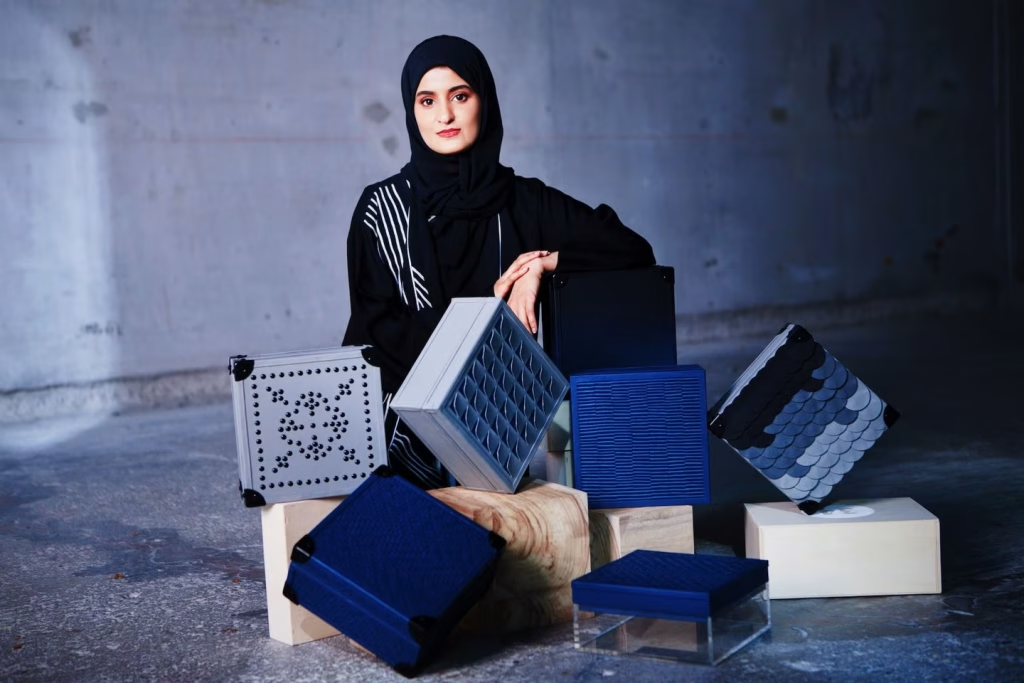
Aljoud Lootah runs her eponymous studio out of Dubai Design District, producing furniture that treats Emirati heritage as raw material rather than reference. Her background is in graphic design — she created the limited-edition Unfolding Unity stool in 2013 before launching her debut furniture collection at Design Days Dubai in 2015 — and that lineage shows: geometry, pattern, and precise repetition run through everything she makes. Her Oru Series, inspired by origami, explores the idea that folding a flat two-dimensional sheet can produce aesthetically compelling three-dimensional forms. Later collections moved closer to Emirati craft tradition: her AlSadu collection drew on the geometric weaving practised by women in rural Emirati communities, a practice that has since been listed on UNESCO’s Intangible Cultural Heritage register. The studio’s reach extends well beyond the region. Two pieces from the Oru Series were acquired by the National Gallery of Victoria in Melbourne, making Lootah the first Emirati designer to have work collected by an international gallery. Commissions include the Mandarin Oriental Dubai, Etihad Airways, and a bespoke gift presented to Pope Francis on his visit to the UAE in 2019.
AICHA ALYASSI
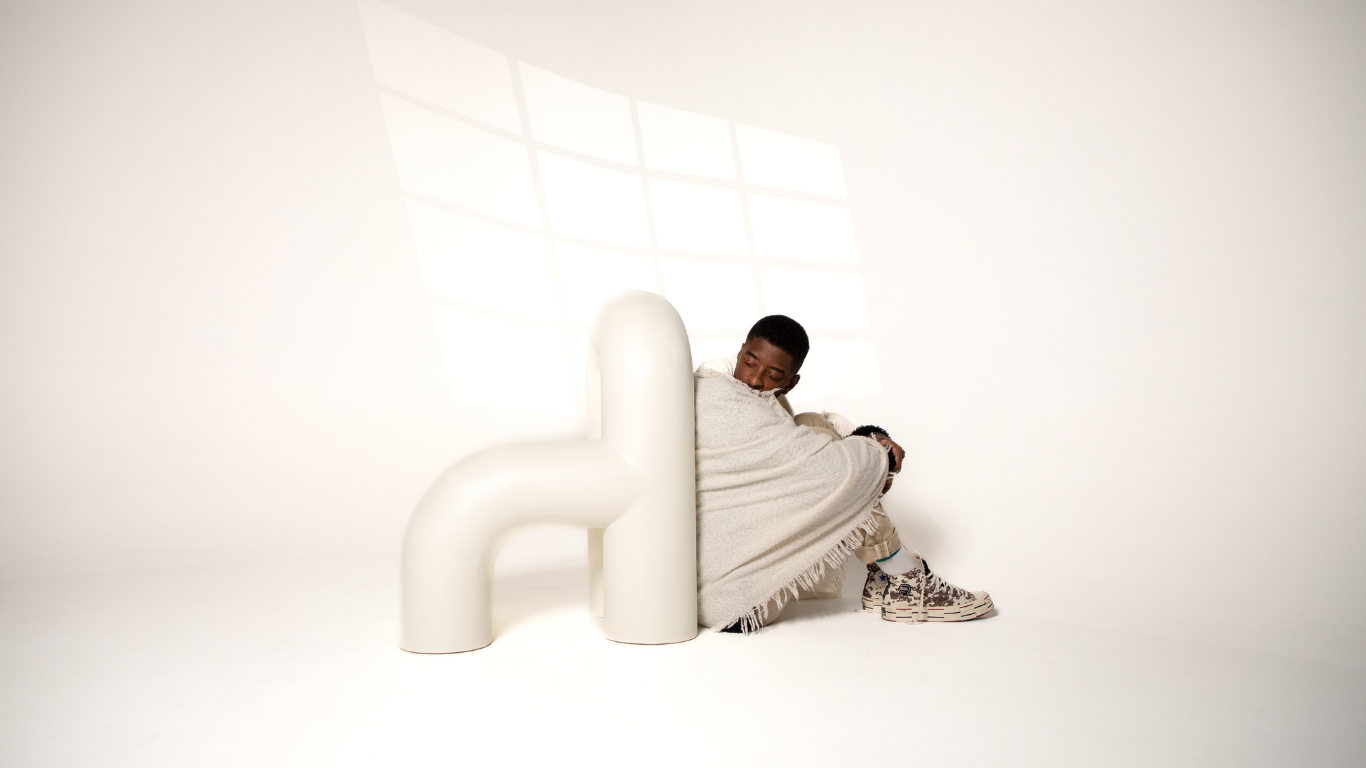
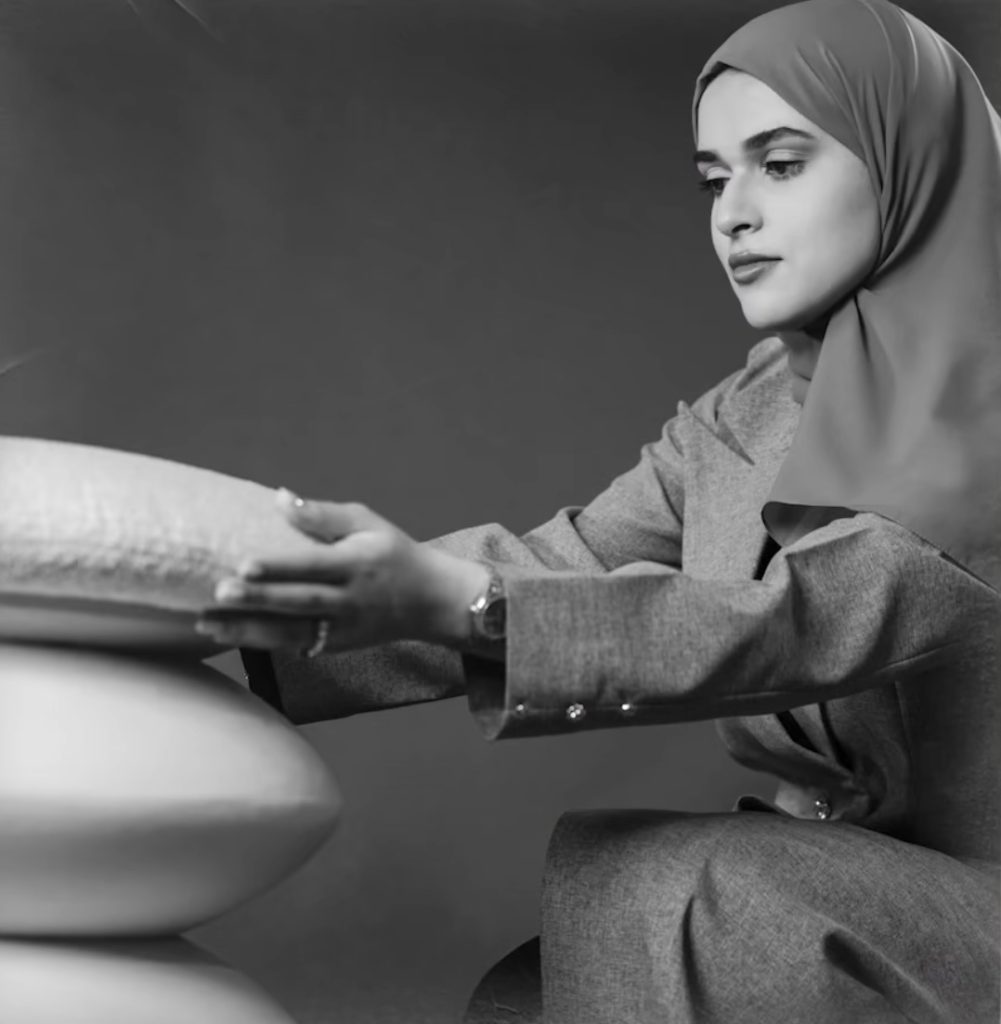
Aicha Alyassi founded Dachah Studio (former name) in 2023, and made an immediate impression at that year’s UAE Designer Exhibition at Downtown Design in Dubai. The studio’s debut pieces were grounded in precise cultural observation: the Kuthub Chair drew from the smooth curvature of desert dunes, its apparent visual discomfort a deliberate reference to the harshness beneath the dunes’ surface, while the Qurs Stool paid tribute to the circular agal headwear and the traditional Gulf baked good known as qurs ugaili, finding in everyday Emirati life the raw material for form. Her more recent work under the new name, Aicha Studio, includes the Muntaha Bench, a sculptural piece shown at Downtown Design whose undulating form captures the rhythm of personal challenge and growth — its curves intended as a reminder that both ascent and difficulty are part of a continuous cycle. Her approach is rooted in translation: taken individually, each piece reads as an elegant object; read together, they form a quiet inventory of Emirati material culture rendered in contemporary furniture. She is among the most closely watched names in the UAE’s next generation of designers.