


Behind the glittering retail corridors and global fashion weeks, a radical shift is taking hold. A new generation of UAE-based designers and founders is proving that environmental responsibility and genuine style are not competing ambitions, and they are doing it in ways that are inventive, principled, and often deeply personal. Here are five brands leading the charge.

The Giving Movement
When British founder Dominic Nowell-Barnes launched The Giving Movement in 2020, Dubai was still navigating the uncertainty of the pandemic. It wasn’t the most obvious moment to build a fashion brand from scratch, but Nowell-Barnes had a clear and urgent premise: that the conventional profit-first model of fashion lacked deeper purpose, and that small acts, multiplied by many, could change the world.
Now at one of the UAE’s best-known homegrown labels, every piece is designed and produced locally, with fabrics sourced from sustainable international suppliers and all production and finishing carried out in the Emirates.
The materials used in the clothing include recycled water bottles and organic bamboo, engineered into lightweight, breathable textiles. Each garment carries a mint-green tag detailing exactly how many waste bottles were used in its making and all its packaging is biodegradable.
Four dollars from every purchase is donated to charitable causes, and the brand has now surpassed AED 20 million in total donations, channelled through organisations including Dubai Cares and Harmony House India.
The collections span activewear, loungewear, and streetwear, with a modest line for hijab-wearing customers and children’s pieces more recently added. The Giving Movement is proof that purpose-driven fashion can also be commercially formidable.

Reemami
Designer Reema Al Banna launched Reemami in Dubai in 2009, well before sustainability became the industry’s most cited buzzword. She didn’t have a manifesto so much as a method: source carefully, produce locally, cut nothing to waste. Over the years, that method has become a fully articulated practice that touches every stage of the supply chain.
Reemami’s aesthetic is unmistakable, with architectural silhouettes, hand-illustrated graphics, boldly clashing prints that are simultaneously eclectic and precise. To realise those prints, Al Banna draws on local deadstock fabrics and GOTS-certified organic cotton and denim, dyed and silk-screen-printed using processes that significantly reduce both water use and chemical discharge. Even the offcuts that most ateliers discard are repurposed into headbands and neck scarves. Collections are produced in limited runs, a seasonless approach that resists overproduction by design.
Recognised by Fashion Trust Arabia and a long-standing presence at regional fashion weeks, Reemami remains one of the most enduring independent labels in the UAE.
Nature Hedonist
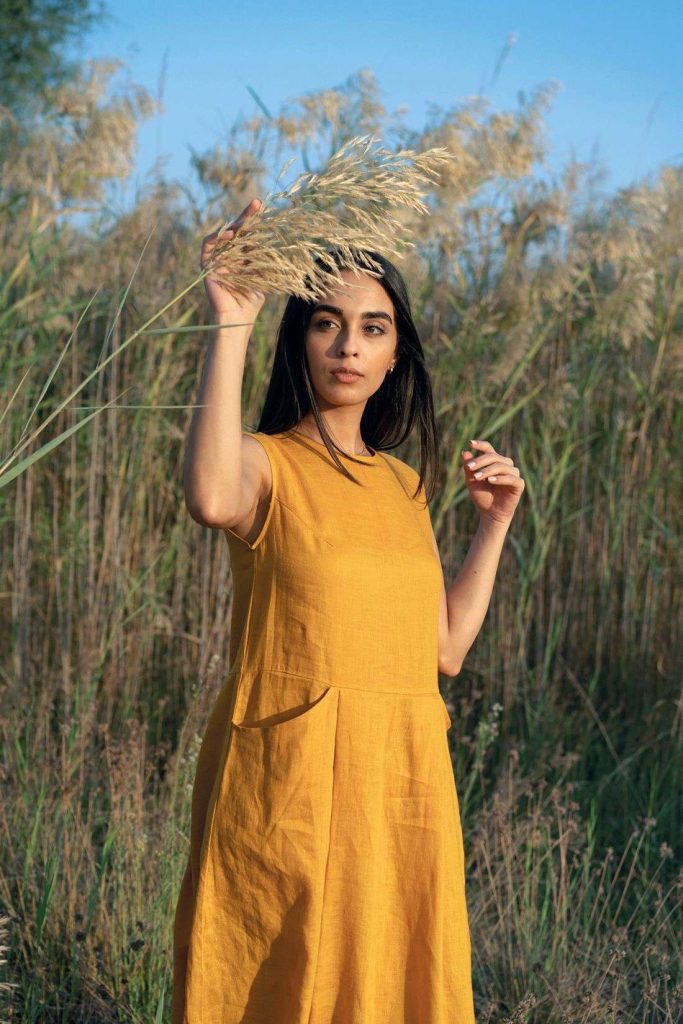
Gulnar Tyndybaeva, from Kazakhstan, co-founded the brand with Julia Sukhanova shortly before the onset of the pandemic in 2020, after both had experienced burnout: Tyndybaeva from running a marketing agency in Central Asia, Sukhanova from a parallel world of high-pressure work. What they built together is a label grounded entirely in linen, and in the argument that less can be categorically more.
Linen grows naturally and requires little water; its durability means it ages gracefully, absorbs sweat without complaint, and can be air-dried rather than washed after every wear, a material whose properties reduce water and electricity consumption simply by being what it is. Every piece is designed from Oeko-Tex-certified and European Flax Standard linen, ensuring each garment is soft, durable, and machine washable. Collections are kept seasonless, with effortless silhouettes and a colour palette drawn directly from the natural world: dust, stone, water, earth.

Nomad
NOMAD’s founding concept was drawn from the Bedouin tradition: the idea that a nomadic community is, by nature, sustainable: resilient, self-sufficient, leaving no trace. Founder Nesa Rassouli, who has lived in Dubai her entire life, built the brand around that inheritance and the equally modern reality of the UAE’s third-culture identity, the expat sensibility of living between cultures, always on the move, and calling somewhere home that you were not originally from.
From its first day, NOMAD demonstrated its sustainability commitment through recycled and recyclable packaging, and a combination of natural fibres and recycled materials for its fabrics, finishes, tags, and trims, with everything designed and manufactured locally in small batches to minimise waste. Fabrics span cotton, linen-cotton blends, Tencel, organic cotton rib, and recycled polyester , with suppliers required to present certifications including GRS and SEDEX. The limited-run production model is deliberate: customers do not simply buy a dress, they acquire something finite. Sustainability, for NOMAD, has always extended beyond materials to the question of who fashion is actually made for — and the answer, consistently, is everyone.

Color Story by Dee
For Color Story, sustainability is about longevity and meaning. Adding more to the volume of clothes already being produced on the planet, without intention didn’t sit right with them, so they leaned towards doing things in a way that is purposeful and mindful.
At Color Story, sustainability is embedded in how they design and produce, with a focus on small-batch, limited-edition collections to avoid overproduction. Their approach also leans into made-to-order and customization, which allows them to reduce waste and create something more enduring for clients.
They also focus on consciously extend the life of their materials. Fabric remnants are not discarded they’re reimagined into home décor pieces like cushions and lamps, giving new meaning to what would otherwise be waste. Their production remains hyper-local, supporting smaller ecosystems and reducing the footprint that comes with mass manufacturing. “We’re not trying to save the world with a cushion made from fabric scraps. But we are trying to make sure nothing we create goes to waste and that is a start,” says founder, Deepti Khanna.
Color Story’s ethos is a reminder that sustainability is about slowing down, even in small ways and making choices that are responsible, intentional and honest.