



Words by Ayesha Shaikh
Dhaher Bin Dhaher, the Emirati founder of Tola, speaks fluent perfume. His vocabulary? Memory, moments, and measure.
Have you ever met a perfume with a point of view? Dhaher Bin Dhaher has. Quite a few, in fact.
Gulnaz has a weakness for saffron and leather. Shahzada likes grapefruit with a crack of pink pepper. For Misk Begum, naturally, white musk is something of a must. Malika comes alive after dark, dressed in jasmine and orange flower. Mehmaan arrives bearing lavender, leaving oud in its wake.
And that’s only part of the dramatis personae at Tola, the niche, Dubai-born perfume house Dhaher envisioned in 2010 and launched three years later. “I never start with a name,” he says. “The fragrance tells me who it is. Sometimes, it feels elegant, sometimes confident, sometimes nostalgic.”
Tola’s characters – 17 at last count – know that a crowded room rarely makes for better conversation. “I’ve learnt that sometimes the hardest decision is knowing when to stop,” reflects Dhaher. “When removing one note takes away from the story instead of improving it, I know I’ve found the balance. The fragrance has said everything it needs to say.”
Dhaher is a collector of impressions, and perfume is what happens to some of them. “My notebook is rarely full of formulae,” he says. “It’s usually observations – a sentence, a hotel lobby, rain on stone, a café, the smell of an old book.”
Some eventually become fragrances, taking on meanings beyond Dhaher’s own. “Growing up in the UAE, bukhoor was something everybody understood,” he notes. “What surprised me wasn’t that people from different cultures liked different scents – it was that they responded emotionally for the same reasons.”
Memory, after all, is an unruly perfumer. “I’ve seen someone in Europe smell oud and think of an old wooden library, while someone from the Gulf thinks of Eid at their grandparents’ house,” Dhaher recounts. “Completely different memories, yet the same emotional reaction. That’s when I realised fragrance has its own language.”
Dhaher learnt that language early and its vocabulary came from his mother. But was she introducing him to perfumery, or to a way of paying attention to the world? “I don’t think she was trying to teach me perfume. She was simply being herself,” he recalls. “She’d make oils and bukhoor for family and friends, and I was always watching.”
“Looking back, I realise she was teaching me to notice things most people overlook – the way a home has its own scent, how someone prepares for guests, and how fragrance can make people feel welcome before a conversation even begins,” Dhaher explains.
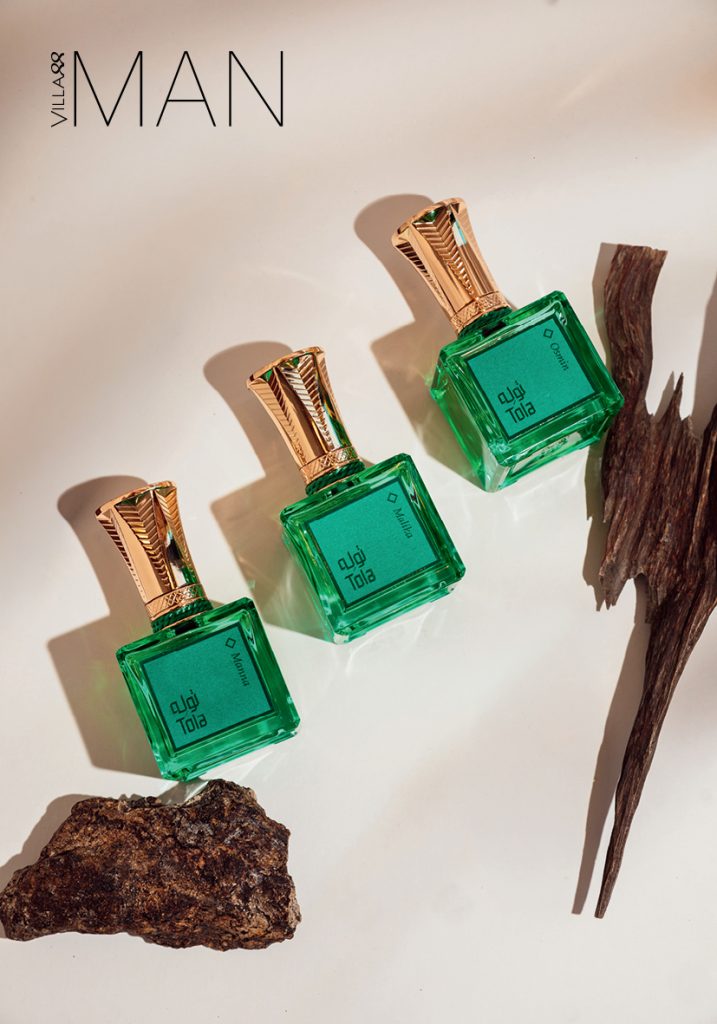
Today, that’s how the perfumer approaches Tola, whose repertoire extends to bukhoor, reed diffusers, and home and linen fragrances. And his attention hardly stops at the scent itself. “I’ve never believed the bottle is separate from the fragrance,” he reveals. “The green reminds me of growth and nature. The coin-shaped cap represents value – not monetary value, but something worth keeping.”
While a perfume may be complete, Dhaher the perfumer is far from finished. “I think we’re all evolving. If I created the same fragrances today that I did ten years ago, I’d be disappointed because it would mean I hadn’t grown,” he comments.
Every Tola fragrance reads like a page from its maker’s unfolding story. “A perfume isn’t just a formula – it’s a time-stamp of the person I was when I created it,” Dhaher shares.
What remains with the wearer when an empty Tola flacon sits on the dresser, like an objet d’art, long after Gulnaz and company have taken their leave? “I hope they don’t remember the perfume first. I hope they remember a moment,” responds Dhaher. “Maybe they wore it on their wedding day, or while travelling somewhere unforgettable.”
“Perfume eventually disappears from the skin, but memories don’t,” he concludes. “If a Tola fragrance becomes part of someone’s memories rather than simply something they wore, then I’ve achieved what I set out to do.”