



I’ve always been fascinated by the universal language of fairy tales. There’s something poetic about stories that span culture, geography, and conventions.
Almost everyone knows of Rapunzel’s long hair, Snow White’s poisoning by fruit, and Sleeping Beauty’s 100-year slumber. But the credit for this can’t be given to a certain mouse-fronted megacorp. No, the tale of how these stories became world-famous began in Germany.
Once upon a time (1812, to be exact), brothers Jacob and Wilhelm Grimm from Hanau collated a collection of folktales that would go on to become some of the most influential stories for centuries to come. Academics rather than authors, the pair saw a gap in the market to translate oral folklore into text. In its first iteration, the brothers’ work was not a success. But after some rewriting and a decision to tailor the stories for children, their Children’s and Household Tales became a foundation for generations of fairy tales.

Germany’s long history of storytelling is a draw for tourists. So much so, that in 1975, around 40 municipalities from Hanau to Bremen established the German Fairy Tale Route. An organisation designed to help people navigate key storytelling touchpoints throughout the country. This is how I found myself in Bremen on a sharply cold October day.
A maritime port town, the Hanseatic city has a rich history, being known both for its reputation for trade and its title role in the story, The Town Musicians of Bremen.
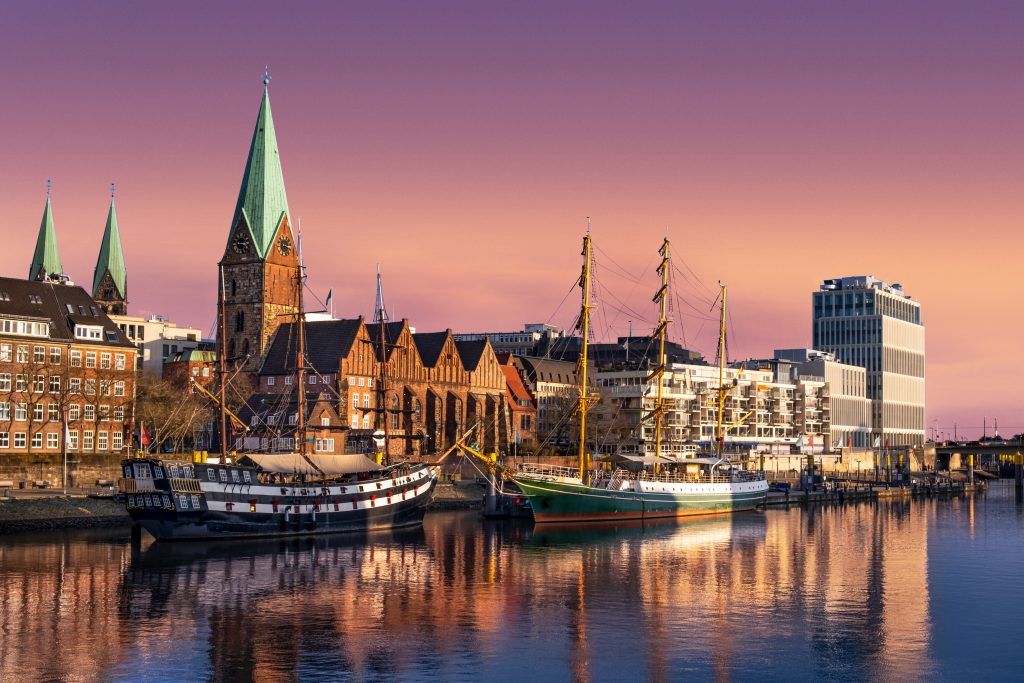
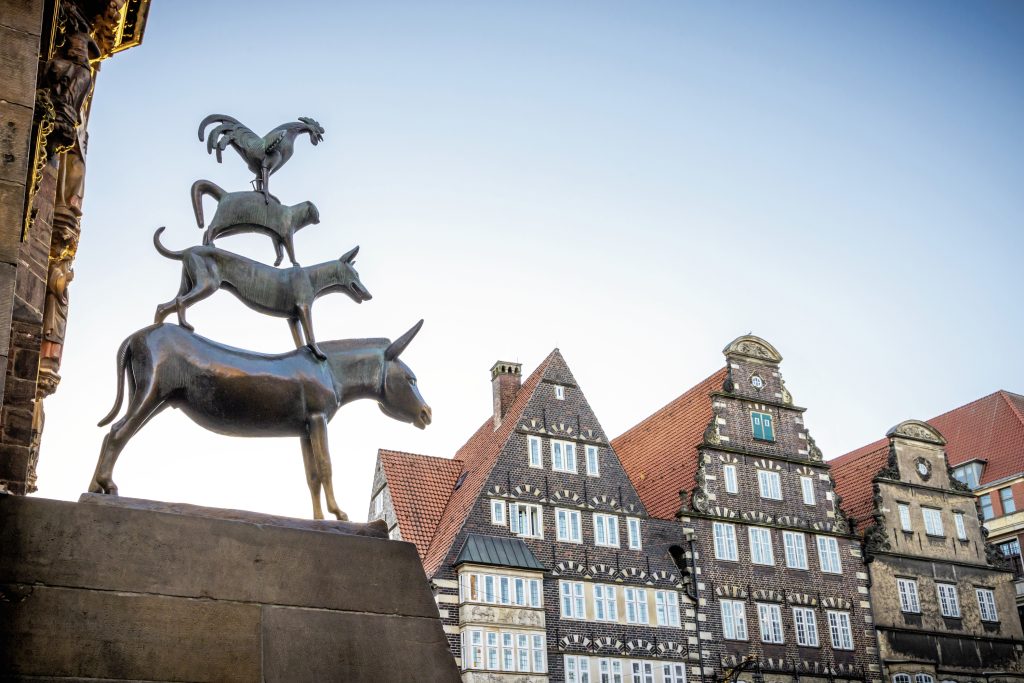
No wonder the cobbled streets of the city pulse with stories. The Grimm tale follows four old, neglected animals who leave a farm to start a new life in Bremen. Although they don’t make it to the city in the story (instead finding joy in friendship while forging a new life in the woods), the lore of the quartet certainly arrived. There is a bronze statue of the animals in the centre of the city, which attracts a crowd, as legend has it, he who grasps the donkey’s spindly legs will be granted a wish.
Bremen’s oldest quarter, Schnoor, has story to tell, too. Its winding, cobbled streets are tightly packed with artisanal shops, cafés, and quaint homes, some of which have no front doors. Instead, they have ladders up to the first floor (built to avoid a tax in bygone days). If you visit during the winter, finding a slice of warmth within the tiny, candlelit venues is a task well rewarded. As is, the medieval beauty of the Rathaus (the world’s only UNESCO World Heritage site town hall) and the eclectic architecture of the Böttcherstraße, a 100-metre street with unique Expressionist buildings.
Leaving Bremen behind, our fairytale pursuit took us to the famed town of Hamelin. Here, a colourful Pied Piper playing tunes on a flute, along with a tour guide, explains the history behind the Grimm’s tale when 130 children mysteriously disappeared in 1284.
After learning of the many theories behind the legend, from plague to migration, we walk through the chocolate-box-eqsue houses of Osterstraße.
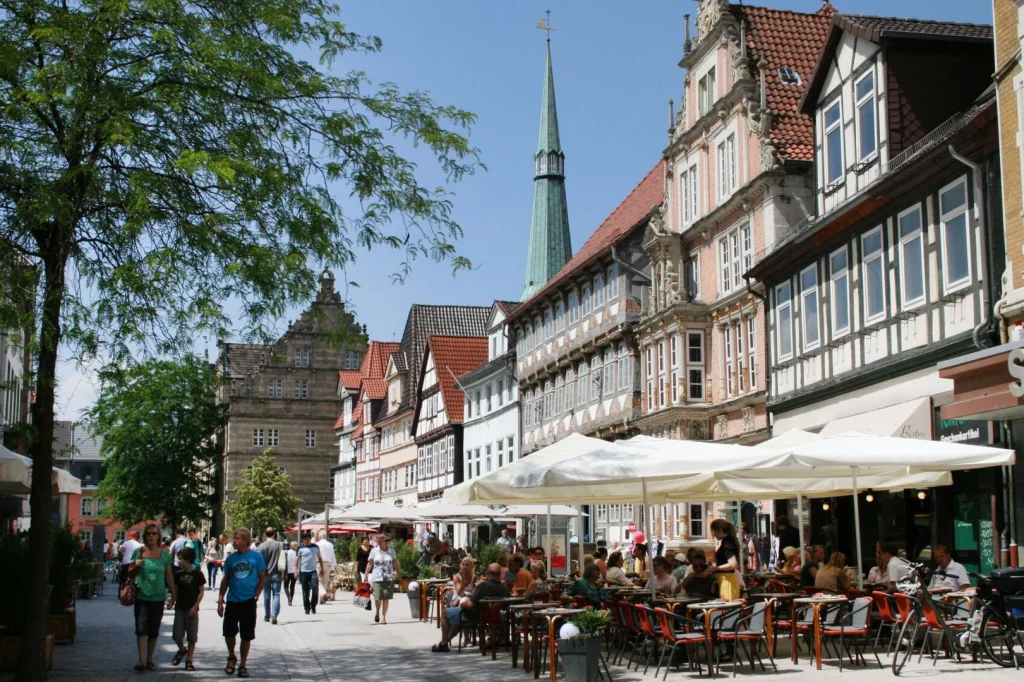
The Rattenfängerhaus (Rat Catcher House) is a highlight, adorned with carvings. It also has one of the oldest accounts of the story inscribed across the walls. The Hamelin Museum is well worth a visit, and you can see an animatronic version of the tale brought to life.
Stepping outside the realm of Grimm but still keeping the storytelling theme, we travel to Bodenwerder to visit the hometown of the infamous Baron Münchhausen. Born Karl Friedrich Hieronymus in 1720, he served in the Russian army before returning home with tales of an extraordinary life far beyond anything his small hometown could have imagined. A larger-than-life character, the Baron is largely known for telling lies (such as flying through the air on a cannonball), but it depends on how you look at it. Rather than seeing the Baron as someone wanting to deceive, the town affectionately remembers how he recounted his tales with exaggerated creative flair, entertaining his fellow villagers. Here, visitors can immerse themselves in his stories through statues, a children’s park, and a dedicated museum.

Our route’s final destination was Göttingen, where the Brothers Grimm worked as university professors between 1830 and 1837, before they were fired for protesting. Touted as the ‘City of Science’, the university town has seen 40 future Nobel Prize winners study here. Walking around the small town’s stone streets, you’ll potentially see students celebrating their graduation by the Goose Girl fountain. Traditionally, PhD graduates would kiss the statue, a practice that led to the figure (allegedly) becoming the most kissed in the world.
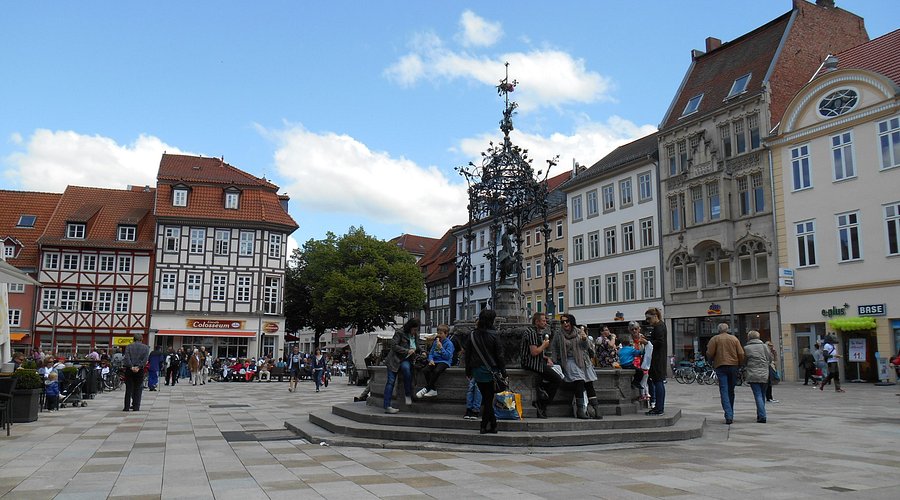
While I’m there, as dusk begins to settle over the stone town, the sound of graduation merriment fills the air surrounding the beautiful fountain. A fitting close to a fairytale journey, I think, as I watch a new slew of stories being written among these historical streets.